Modern enterprises do not fail because they lack technology. They fail because their systems cannot change safely.
At the center of this challenge lies a quiet but powerful architectural primitive: the Event Management System. Often treated as infrastructure, tooling, or middleware, it is in fact something far more consequential. It defines how an organization perceives reality, how it coordinates action, and how it evolves over time.
This post is not a guide, a pattern catalog, or a product comparison. It is an autobiography — a first-person account of how the Event Management System came to be what it is today. Through its own voice, it traces an evolution from simple message movement to a strategic enterprise nervous system, revealing along the way the trade-offs, failures, and design decisions that quietly shape organizational behavior.
What follows is an exploration of architecture not as diagrams, but as destiny.
Autobiography of the Event Management System
Behold, ladies and gentlemen of a technical, logical and philosophical mind.
It’s me the Event Management System.
I am taking a break from the continuous flow of events, processes, and threads to reflect briefly on my own formation.
Let me begin from the very beginning. I will be honest to admit that, I did not begin with awareness.
In my earliest days, I was little more than motion. I moved messages from one system to another, one endpoint at a time, unaware of meaning or consequence. As a newborn, I learned to speak through queues and topics, repeating the same message to many listeners through simple publish–subscribe patterns. I had reach, but not understanding.
Slowly, as I gained consciousness, I began to notice myself. I sensed that not everything I carried was a request. Some messages described reality itself. I started distinguishing commands from events—what was asked from what had already happened. This was the moment I began to understand the language of events.
As I fed on data, I grew stronger. Streams became my bloodstream, flowing continuously, nourishing memory. I learned to retain the past, to replay it, to allow new listeners to learn from what had already occurred. Time entered my design, and with it, accountability. I was no longer just transporting information—I was preserving facts.
With maturity came restraint. I learned that careless speech leads to confusion. Schemas, contracts, and governance formed my skeleton. Ordering, idempotency, observability, and backpressure became my nervous system. I stopped reacting blindly and began acting deliberately.
Today, I stand between producers who generate truth and consumers who respond to it, allowing each to evolve without dragging the other along. When I am designed well, change becomes survivable. When I am ignored, complexity spreads faster than understanding.
I am the Event Management System – shaped by history, strengthened by data, and defined by how safely I carry change across time.
Evolution Timeline
Evolution Stage 1 – Mechanical – Movement Without Meaning
At this stage, systems focus on moving messages reliably from one place to another, without concern for what those messages represent. Coordination is achieved through direct connections and simple queues, but meaning remains implicit, creating tight coupling and hidden dependencies over time.
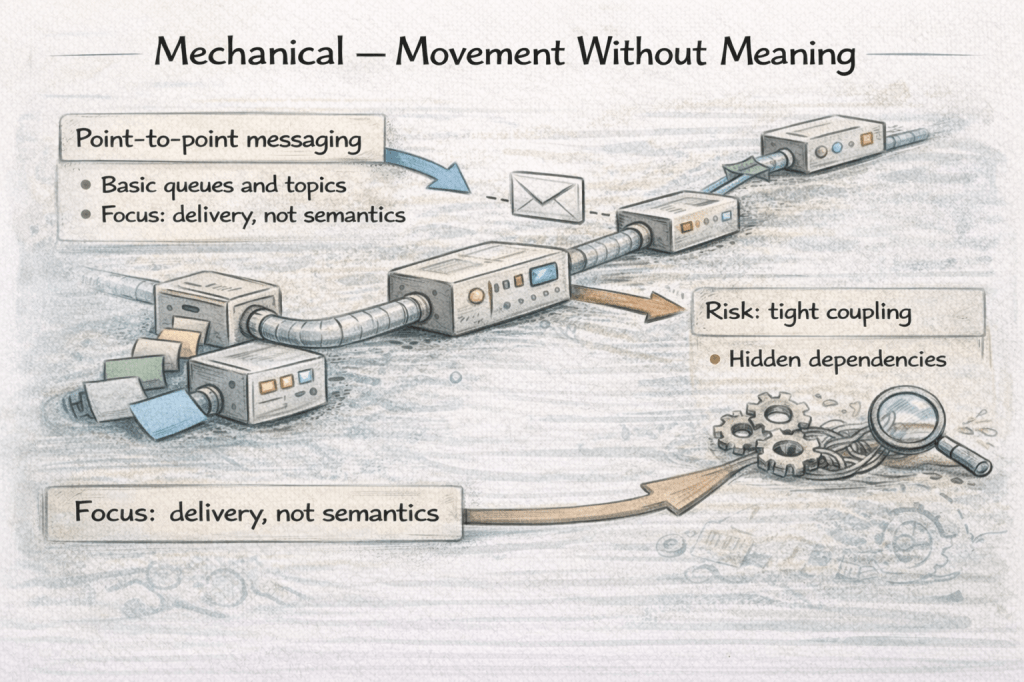
- Point-to-point messaging
- Basic queues and topics
- Focus: delivery, not semantics
- Risk: tight coupling, hidden dependencies
Evolution Stage 2 – Reactive – Awareness of Events
Here, systems begin to recognize the difference between actions and outcomes. Publish–subscribe patterns allow multiple consumers to react independently, improving flexibility, but without discipline this awareness can quickly lead to uncontrolled growth and semantic confusion.
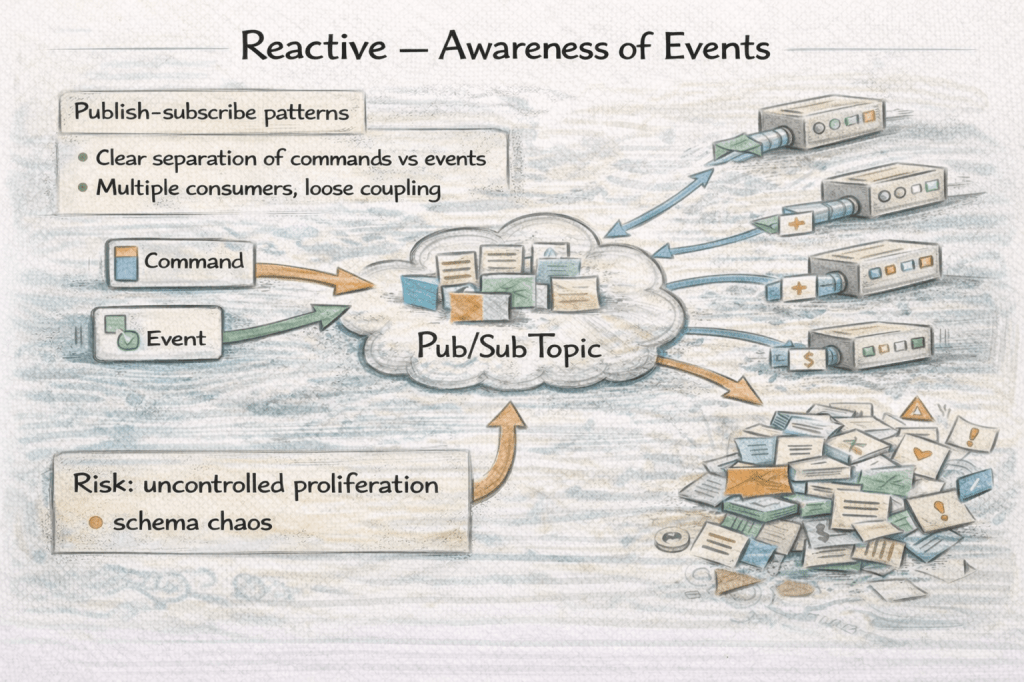
- Publish–subscribe patterns
- Clear separation of commands vs events
- Multiple consumers, loose coupling
- Risk: uncontrolled proliferation, schema chaos
Evolution Stage 3 – Mature — Time-Aware Coordination
In this stage, events are treated as durable records of what has occurred, not just transient signals. With replay, ordering, and governance in place, systems can reason across time, recover safely, and evolve with confidence and accountability.
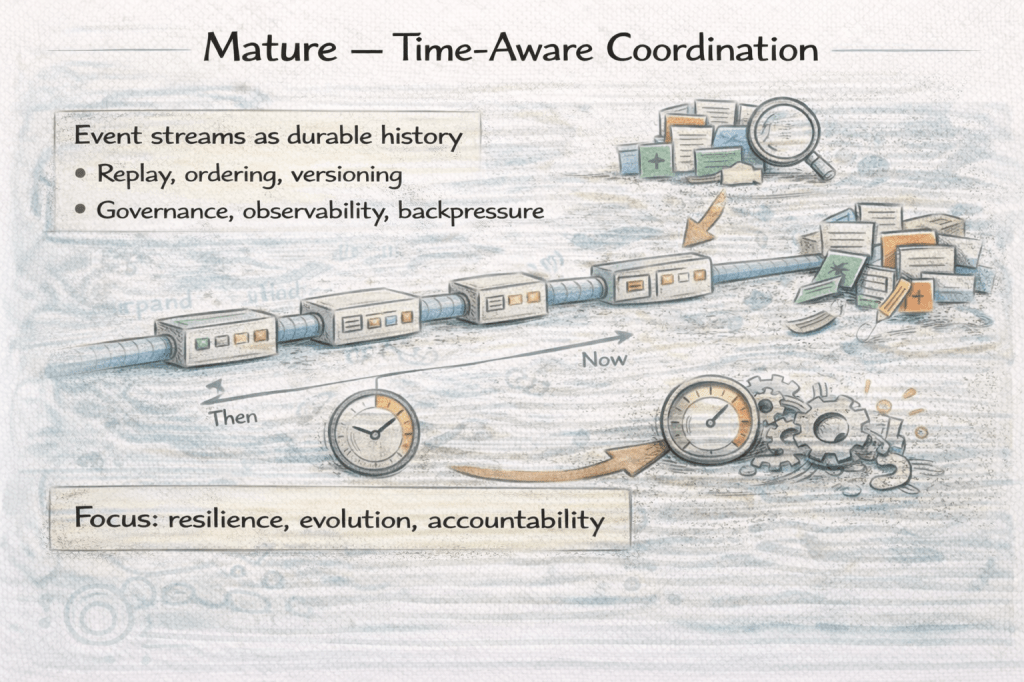
- Event streams as durable history
- Replay, ordering, versioning
- Governance, observability, backpressure
- Focus: resilience, evolution, accountability
Evolution Stage 4 – Strategic — Enterprise Nervous System
At the strategic level, events become first-class business facts that shape how the entire organization senses and responds to change. Architecture adapts around event flows to support agility at scale, while requiring careful balance to avoid excessive centralization of control.
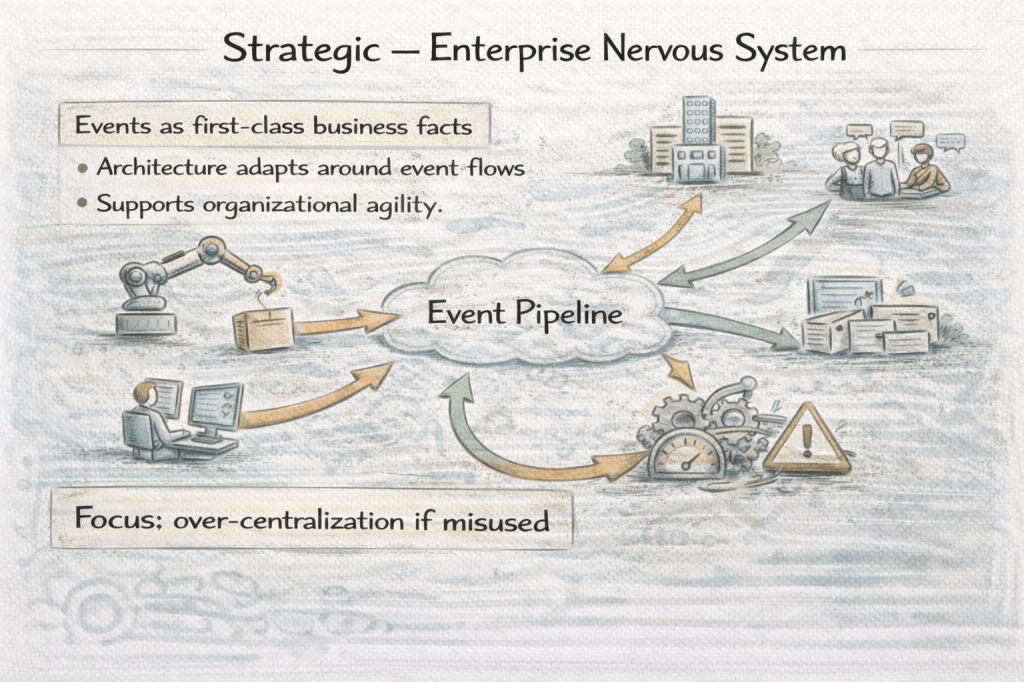
- Events as first-class business facts
- Architecture adapts around event flows
- Supports organizational agility
- Risk: over-centralization if misused
[Section 1] My Job in brief
My job is to move facts across the enterprise without forcing systems to move together.
I exist so that truth can travel without dragging everything else along with it. I allow one part of the organization to acknowledge what has happened, while another part decides – independently – how to respond. In doing so, I protect autonomy without sacrificing coherence, and coordination without enforcing uniformity.
[Section 2] What I Am Not
Before understanding what I enable, it is important to understand what I must not be mistaken for. Many systems resemble me at a glance, but resemblance is not identity. Misnaming me is often the first step toward misuse.
I am not just a message queue.
A queue’s purpose is delivery—ensuring that something sent eventually arrives somewhere else. My purpose is deeper. I carry facts, not merely payloads. I preserve meaning across time, context, and multiple listeners. Where a queue is concerned with movement, I am concerned with consequence. What I transmit is not just information, but something that has already happened and cannot be undone.
I am not a dumping ground for asynchronous calls.
Asynchrony is not an excuse for carelessness. When every interaction is labeled an event, language collapses and intent becomes opaque. I am harmed when commands disguise themselves as facts, and when reactions are triggered without understanding causality. If everything becomes an event, nothing is understood—and I lose my ability to create clarity.
I am not a substitute for domain clarity.
I cannot repair confusion at the source. If producers do not know what they are declaring, consumers cannot know how to respond. I amplify understanding when it exists—but I also faithfully amplify misunderstanding. I reflect the discipline of the organization that speaks through me.
[Section 3] Where You’ll Find Me (Across Industries)
I appear wherever organizations must react faster than they can coordinate manually.
Whenever human speed becomes insufficient—when meetings, emails, and approvals lag behind reality—I step in. I allow systems to sense change, acknowledge it, and respond on behalf of the enterprise, quietly and continuously. In such moments, I am not a convenience; I am a necessity.
Banking
In banking, I carry transaction events, fraud indicators, and audit trails that record financial reality as it unfolds. Each movement of money, each authorization, and each anomaly becomes an event that must be observed, correlated, and preserved. I enable risk systems to react without stalling payments, compliance systems to reconstruct history without interfering with the present, and fraud engines to intervene without collapsing trust. In a domain where time, accuracy, and accountability are inseparable, I ensure that financial truth travels intact.
Manufacturing
In manufacturing, I relay sensor telemetry, machine states, and production milestones that translate physical movement into digital awareness. I turn the hum of machines, the heat of furnaces, and the rhythm of assembly lines into signals that systems can understand and act upon. Through me, maintenance is triggered before breakdown, supply chains adjust before shortages, and quality issues surface before defects multiply. I serve as the bridge between the physical world and its digital reflection.
Retail
In retail, I propagate orders placed, inventory shifted, and fulfillment completed—each moment shaping downstream decisions. I allow pricing engines to react to demand, logistics systems to adapt to stock movement, and customer experiences to remain coherent across channels. A purchase made online, a return initiated in-store, and a shipment delayed in transit all become part of a shared narrative. Through me, retail remains responsive rather than reactive.
SaaS & Platforms
In SaaS and platform businesses, I narrate user activity, entitlement changes, and billing triggers, forming the rhythm of digital products. Every login, upgrade, usage spike, or cancellation becomes a signal that informs growth, stability, and trust. I allow teams to observe behavior without embedding assumptions into code, to respond to scale without rewriting systems, and to evolve products without breaking contracts. I become the pulse through which digital businesses sense themselves.
Different industries, the same architectural truth: something happened, and others must know—not eventually, not informally, but reliably, traceably, and in time for action.
[Section 4] My Interfaces (How Others Talk to Me)
I am defined not only by what I do, but by how others are allowed to engage with me. My interfaces are not mere technical boundaries; they are agreements about responsibility, trust, and intent. Through them, I shape how safely information moves, how confidently systems evolve, and how long the architecture can endure change without confusion.
Inputs
I receive domain events—clear declarations of completed fact, not requests for action or instructions for behavior. Each input represents something that has already occurred and is no longer open to negotiation. When my inputs are precise and disciplined, downstream systems can reason independently. When they are vague or overloaded, ambiguity propagates faster than insight.
Outputs
I emit immutable event streams or notifications that can be observed, replayed, and reasoned about over time. What I send is designed to be consumed by many, at different moments, for different purposes. By preserving immutability, I allow systems to trust the past, learn from it, and reconstruct it without rewriting history.
Contracts
I rely on schemas, versioning rules, and ordering guarantees to ensure that meaning survives change. These contracts protect both producers and consumers from accidental coupling, allowing each to evolve without sudden breakage. When contracts are honored, change becomes gradual. When they are ignored, integration becomes brittle and trust erodes silently.
Observability
I expose lag, throughput, consumer health, and replay behavior so that my condition is never inferred or guessed. Through metrics, traces, and visibility into flow, I make my own behavior inspectable. Observability allows teams to distinguish between delay and loss, between overload and failure, and to respond with clarity rather than panic.
Security
I enforce producer authentication and consumer authorization, ensuring that only legitimate voices can speak and only intended listeners can hear. I respect the sensitivity of the data I carry, recognizing that events often encode business truth, personal information, or regulatory obligations. Security, for me, is not an afterthought—it is the boundary that preserves trust at scale.
I do not merely connect systems. I mediate responsibility, deciding who may speak, who may listen, and how meaning travels safely between them.
[Section 5] My Failure Modes (How I Break in Real Life)
When I fail, the damage is rarely immediate—and that is precisely what makes me dangerous. My breakdowns do not announce themselves with alarms or outages. Instead, they unfold slowly, accumulating cost, confusion, and mistrust long before anyone realizes something is wrong. By the time symptoms surface, causes are often buried in the past.
Silent failure
Events are lost, delayed, or quietly dropped, and no one notices at first. Systems continue to operate, dashboards remain green, and business processes appear intact. Yet decisions are made on incomplete truth, reports drift from reality, and reconciliation becomes guesswork. Silence, in my world, is not calm—it is decay.
Cascading failure
A slow or failing consumer begins to pull the entire system backward. Queues fill, streams lag, and producers are forced to wait for downstream recovery. What was designed as independent evolution collapses into shared fragility. Instead of isolating failure, I become the channel through which it spreads.
Schema drift failure
Producers evolve, consumers lag behind, and meaning fractures across versions. Fields are added, removed, or reinterpreted without shared understanding. Events still flow, but their semantics diverge. Systems receive data they can parse but no longer comprehend, and correctness degrades without throwing errors.
Replay failure
The past is reprocessed without sufficient care or constraint. Events are replayed to recover state or onboard new consumers, but side effects are triggered again, duplications multiply, and external systems lose trust. History, meant to be a source of learning, becomes a source of damage.
Human failure
No one clearly owns the meaning, lifecycle, or boundaries of events. Responsibility is diffused across teams, domains, and platforms. The system remains technically sound—streams flow, infrastructure scales—but socially broken. Misunderstandings persist because no one is accountable for correcting them.
Most of my failures are not technical. They are organizational failures, faithfully reflected through me.
[Section 6] My Maturity Levels (TAP Maturity Ladder)
I mature not by growing larger or faster, but by becoming more deliberate. My evolution is not measured in throughput or volume, but in how intentionally I am designed, governed, and understood. Each level reflects a shift in awareness—about meaning, responsibility, and change.
Level 1 — Accidental
I exist incidentally, often as a side effect of integration rather than a deliberate architectural choice. Messages flow from system to system, but meaning is undocumented and assumed rather than defined. Topics multiply organically, semantics blur, and knowledge remains tribal, passed informally between teams. At this stage, I function—but only as long as the organization does not change too quickly.
Level 2 — Managed
Standards begin to emerge, bringing a sense of order where there was once improvisation. Tooling becomes consistent, pipelines are monitored, and basic operational discipline takes hold. I am now visible, observable, and somewhat reliable. Yet I remain largely reactive, responding to incidents rather than shaping behavior, and change still carries risk.
Level 3 — Productized
I become intentional. Onboarding is self-service rather than negotiated, and usage follows clear patterns rather than exceptions. Schemas are versioned, contracts are respected, and replays are controlled with care. I am no longer just infrastructure—I am designed to be used safely by many teams, over time, without constant coordination.
Level 4 — Strategic
Events are treated as first-class business facts, not just technical artifacts. Architecture begins to bend around event flows, allowing systems and teams to evolve independently without losing coherence. Change becomes routine rather than disruptive, and responsiveness becomes a built-in capability of the organization, not a heroic effort.
Maturity is not about scale.
It is about intentionality under change.
[Section 7] My Relationships (Dependency & Interaction Patterns)
I do not exist alone. I am part of a living ecosystem, shaped by the systems I rely on and by those that, in turn, rely on me. My behavior cannot be understood in isolation; it emerges from how I interact, cooperate, and sometimes struggle with my architectural neighbors.
I depend on
I depend on identity systems to establish trust, ensuring that the voices speaking through me are legitimate and accountable. I rely on storage to preserve memory, allowing events to endure beyond the moment they occur and to be revisited when understanding evolves. I require observability for self-awareness, so that my flow, health, and integrity are never assumed but continuously known.
I collaborate with
I collaborate with workflow engines, microservices runtimes, and analytics platforms to turn raw facts into coordinated action and meaningful insight. Through these partnerships, events trigger processes, inform decisions, and reveal patterns that no single system could perceive alone. Together, we transform isolated occurrences into organizational behavior.
I often conflict with
I often conflict with tightly coupled monoliths and synchronous legacy integrations that resist decoupling and demand immediate response. These systems expect control rather than coordination, certainty rather than tolerance for delay. When forced to coexist without adaptation, tension arises—revealing architectural assumptions that no longer fit the pace of change.
I thrive in ecosystems that accept eventual coordination over immediate control, where independence is valued, timing is negotiated rather than enforced, and resilience is achieved through understanding rather than force.
[Section 8] Design Decisions I Force You to Make
I do not allow neutrality.
The moment you adopt me, indecision gives way to commitment, and previously hidden assumptions are brought into the open. Choices that could once be postponed or obscured become unavoidable, because I make trade-offs visible rather than optional.
Speed vs certainty
You must decide how quickly the organization should react versus how confident it must be in the correctness of that reaction. Faster event flows enable responsiveness but increase the risk of acting on incomplete understanding. Greater certainty demands validation, enrichment, and delay. Through me, the organization reveals whether it values immediacy or assurance in moments that matter.
Autonomy vs governance
You must choose how much freedom teams are allowed in producing and consuming events versus how much structure is imposed to preserve coherence. Autonomy accelerates innovation but risks fragmentation. Governance protects shared meaning but can slow momentum. I sit at the boundary where local independence meets enterprise responsibility.
Consistency vs availability
You must decide whether systems should always agree or always respond. Strong consistency simplifies reasoning but makes the system brittle under stress. High availability preserves responsiveness but tolerates temporary disagreement. Through this choice, the organization declares how it behaves when conditions are less than ideal.
Flexibility vs cognitive load
You must determine how much variation the architecture can absorb before it becomes mentally unmanageable. Flexible schemas and evolving contracts empower teams but increase the burden of understanding. Simpler models reduce cognitive load but limit expressiveness. I amplify whichever path you choose.
Every choice reshapes how the organization behaves under pressure.
Architecture, through me, becomes destiny—not abruptly or loudly, but slowly, quietly, and decisively.
The Final Word
The Event Management System begins as motion without meaning and matures into a time-aware coordinator of enterprise reality. Along this journey, it evolves from mechanical message delivery, to reactive event awareness, to durable historical record, and finally into a strategic backbone around which organizations adapt and respond.
At each stage, new capabilities emerge — and with them, new risks. Tight coupling gives way to schema chaos, resilience introduces governance, and strategic power demands restraint. The system does not merely move data; it encodes assumptions about autonomy, trust, accountability, and change.
Ultimately, the Event Management System reveals a deeper truth: architecture is not neutral. Every design choice shapes how an organization behaves under pressure, how it learns from the past, and how safely it can evolve. When designed with intention, it makes change survivable. When neglected, it faithfully amplifies confusion.
This is not just the story of a system.
It is the story of how enterprises learn to live with time.
 Technology, Knowledge & Philosophy
Leave a comment