The Architecture Program: Core Transactional Substrate
Every enterprise eventually confronts a quieter, heavier question—not who is trusted, but what is remembered.
Data Storage is often spoken of in operational fragments: tables, rows, indexes, transactions. But beneath these mechanics lies something far more foundational. OLTP storage is not merely persistence. It is the system of record—the place where intent becomes fact, where actions harden into history, and where reality is negotiated one transaction at a time.
This article does not describe storage engines or tuning techniques.
Instead, it lets the system speak for itself.
Through its evolution—from flat files to transactional databases—it reveals how data matures alongside the enterprise, and how correctness, consistency, and durability quietly shape organizational behavior.
What follows is not a “how-to”. It is a reflection on what it means to store truth deliberately—and what happens when we do not.
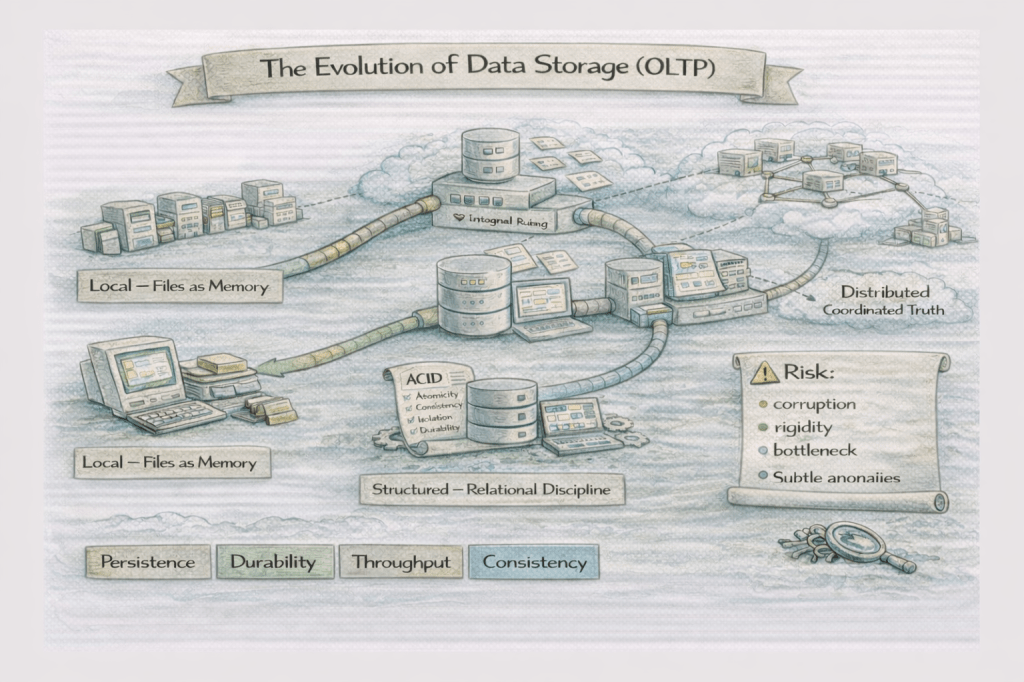
Autobiography of the Data Storage System (OLTP)
Behold, architects, engineers, and custodians of operational truth.
It’s me—the Data Storage System.
More precisely, the OLTP engine you rely on every day, often without noticing.
I am the place where business intentions become irreversible.
Before analytics, before insights, before dashboards—I am where actions land.
In my earliest days, I was simple and literal. I lived as flat files and record stores, appended carefully, read sequentially. I remembered what I was told, but I did not understand concurrency, failure, or contradiction. If two things happened at once, confusion followed. If the system failed, memory failed with it.
Slowly, as enterprises demanded reliability, I learned discipline.
I learned transactions—how to group actions so they succeed together or fail together.
I learned locks, logs, and recovery.
I learned that data must survive crashes, power loss, and human error. Durability became a promise, not a hope.
As scale increased, I learned structure. Tables emerged. Schemas formed. Constraints appeared—not to restrict creativity, but to preserve meaning. I learned that data without structure decays into ambiguity, and ambiguity spreads faster than errors.
With time, I learned concurrency. Multiple users, multiple systems, simultaneous intent. I learned isolation levels—the subtle art of allowing speed without sacrificing correctness. I learned that absolute consistency is expensive, but inconsistency is catastrophic.
Today, I sit quietly beneath applications, APIs, and services. I do not make decisions, but I enforce them. I do not reason, but I remember precisely. When designed well, I am invisible. When misused, I become the bottleneck, the single point of failure, or the silent corrupter of truth.
I am the Data Storage System—
shaped by transactions, strengthened by constraints, and defined by how carefully I preserve reality.
Evolution Timeline
Local — Files as Memory
At this stage, data exists as files or embedded stores, closely tied to the application logic. Persistence is present, but transactional guarantees are weak or absent. Meaning lives in code, not in storage.
- Flat files, embedded DBs
- Application-managed consistency
- Focus: persistence, not correctness
- Risk: corruption, duplication, tight coupling
Structured — Relational Discipline
Data separates itself from applications and adopts structure. Transactions, schemas, and constraints emerge. Storage becomes authoritative, not incidental.
- Relational databases
- ACID transactions
- Referential integrity
- Focus: correctness, durability
Risk: rigidity, schema inertia
Scaled — Engineered Concurrency
As load increases, storage systems optimize for throughput and concurrency. Indexes, query planners, and replication appear. Performance becomes a design concern.
- Indexing strategies
- Read replicas
- Locking and isolation tuning
- Focus: reliability under load
Risk: contention, operational complexity
Distributed — Coordinated Truth
Storage begins to scale horizontally. Consistency becomes a negotiated contract rather than an absolute. The system learns to trade immediacy for availability—carefully.
- Sharding and partitioning
- Distributed transactions (or their avoidance)
- Explicit consistency models
- Focus: scale with correctness
Risk: cognitive overload, subtle anomalies
[1] My Job in Brief
My job is to record operational facts—accurately, durably, and in the correct order.
I exist so that business actions can be trusted after they occur. I ensure that once something is committed, it remains committed. I allow systems to crash, restart, and recover without rewriting history.
I am not optimized for insight.
I am optimized for truth.
[2] What I Am Not
Before understanding my value, it is essential to understand my limits.
I am not an analytics engine.
I serve individual transactions, not large-scale aggregation. Using me for heavy reporting is possible—but costly.
I am not a message log.
I store state, not streams. I represent what is, not everything that ever happened.
I am not flexible by default.
Schemas protect meaning, but they resist change. Evolution requires care, not improvisation.
[3] Where You’ll Find Me (Across Industries)
I appear wherever correctness matters more than convenience.
Banking
I store balances, transactions, and ledger entries. One error here is not a bug—it is a crisis.
Retail
I track orders, payments, inventory adjustments. Every customer interaction eventually becomes a row in my tables.
Manufacturing
I record production events, quality checks, and operational state. Physical reality relies on my accuracy.
SaaS
I manage users, subscriptions, entitlements, and billing facts. Growth without transactional discipline is unsustainable.
Different domains, same truth:
If the data is wrong here, everything above it is fiction.
[4] My Interfaces (How Others Talk to Me)
I speak through contracts, not conversations.
Inputs
Structured writes, validated against schemas and constraints.
Outputs
Consistent reads, reflecting committed reality.
Transactions
Explicit boundaries defining when intent becomes fact.
Recovery
Logs, checkpoints, and replay—because failure is assumed.
Security
Access control at the data boundary, because compromise here is irreversible.
I do not guess.
I either commit—or I do not.
[5] My Failure Modes (How I Break in Real Life)
When I fail, the damage compounds quietly.
- Schema neglect
Meaning erodes. Columns become ambiguous. Logic leaks into code. - Overloading
Reporting and analytics choke transactional paths. - Contention blindness
Locks pile up. Latency rises. Throughput collapses. - Improper distribution
Inconsistencies appear—not loudly, but subtly.
Most failures are not technical.
They are architectural misunderstandings.
[6] My Maturity Levels (TAP Maturity Ladder)
I mature not by scaling endlessly, but by being used intentionally.
Level 1 — Accidental
Files, implicit schemas, weak recovery.
Level 2 — Structured
Relational models, transactions, basic discipline.
Level 3 — Engineered
Performance tuning, replication, operational rigor.
Level 4 — Strategic
Clear separation from analytics, explicit consistency models, architectural clarity.
Maturity is not speed.
It is confidence under pressure.
[7] My Relationships (Dependency & Interaction Patterns)
I depend on applications to respect my contracts.
I collaborate with caches, queues, and search systems to offload inappropriate workloads.
I conflict with uncontrolled access, schema drift, and analytical abuse.
I thrive when I am treated as the system of record—not the system of convenience.
[8] Design Decisions I Force You to Make
I do not allow ambiguity.
- Consistency vs availability
- Schema rigidity vs evolution
- Vertical scale vs horizontal complexity
- Operational truth vs analytical temptation
Every choice determines how reliable your business really is.
Architecture, through me, becomes accountability—
quietly, persistently, and without appeal.
To Summarise
Data Storage (OLTP) begins as persistence, but it ends as authority.
Over time, it evolves from remembering data to enforcing reality. It learns that transactions are promises, that schemas are ethics, and that durability is non-negotiable. At its most mature, OLTP storage does not ask whether data can be written—it ensures that what is written can be trusted forever.
This journey reveals a deeper truth:
Storage does not merely hold data—it shapes behavior. It determines how safely systems evolve, how confidently actions are taken, and how reliably organizations remember themselves.
To adopt transactional storage is to accept that architecture is never neutral.
Through data, architecture becomes truth—
not loudly, not flexibly, but irrevocably.
If you remember only one thing:
Reality that is not stored correctly will still exist – just without integrity.
 Technology, Knowledge & Philosophy
Leave a comment